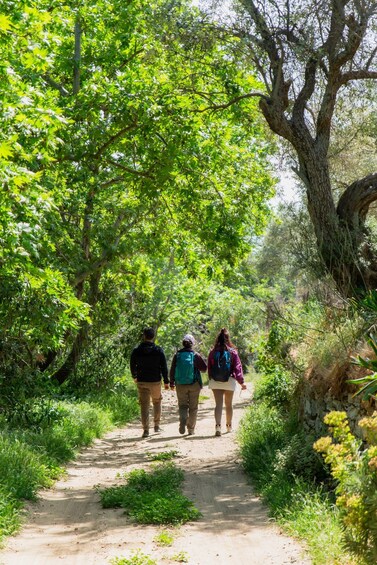
The journey begins in Chalki, the historic heart of Naxos, and gently unfolds westward through the olive groves of the Tragaia Valley. From the very first steps, the landscape invites the walker into a rural setting, where stone paths, ancient trees, and open horizons create a sense of calm and continuity.
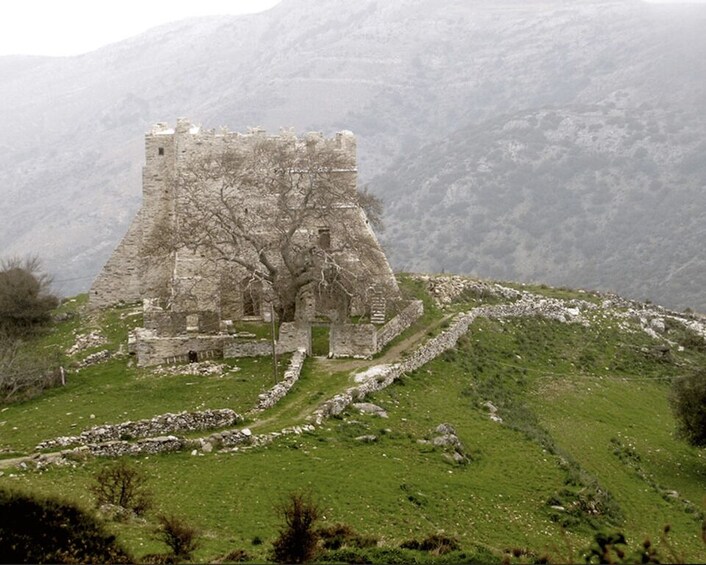
The trail continues towards the imposing rock of Apano Kastro. A challenging side path reveals medieval fortifications, ruined Byzantine and post-Byzantine churches — including the roofless Panagia Kastriani — and panoramic views over central and southern Naxos.
Descending from the castle, the route heads towards Ano Potamia, passing the church of Agios Andreas, renowned for its well-preserved 14th-century frescoes. The walk concludes along a wide stone-paved medieval road connecting the Potamia valley with the Tragaia plateau.
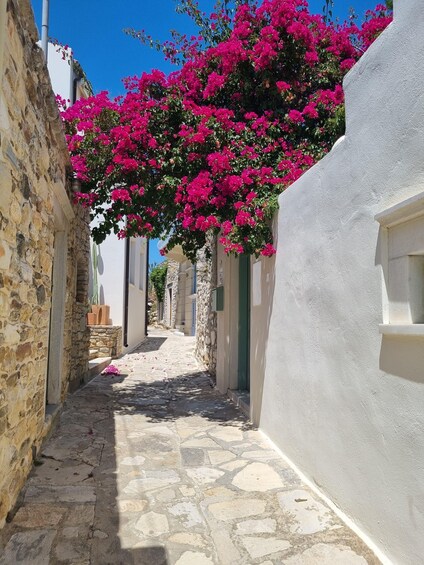
The route unfolds through the fertile Potamia valley, where traditional villages preserve their authentic architecture amid watermills, chapels, stone towers, and cultivated land. Along the way, hikers pass through an ancient landscape shaped not only by nature but also by early human presence, including the Naxos Necropolis, a Geometric-period burial site (9th–8th century BC) hidden among the rocks, where circular tomb remains offer a rare glimpse into the island’s earliest communities.
Τhe trail follows the river, either crossing Mesi Potamia or reuniting at the shaded spot of Platanaki, home to a historic stone washhouse. A short detour leads to the Kokkos Tower rising above the riverbed. The walk continues through orchards towards Kato Potamia and the domed church of Agios Mamas (Theoskepasti), before concluding in Tripodes (Vivlos), a vibrant agricultural village known for its restored windmills and the 16th-century church of Panagia Tripodiotissa.
This route pulses with the energy of centuries past.
Ancient tombs, medieval roads, rivers, towers, and villages weave a living narrative across the landscape of Naxos.
A powerful walking experience where history is not observed — it is felt.
Important information: For our safety we will now walk among the trail as it's not accessible, we will walk next to it and we will have time to photograph and admire the view.
Klm: 6,5