Things to do in Mehedinti County

Activities, attractions and tours

Decebalus is considered a national hero in Romania and has been portrayed in numerous literary works, movies, public sculptures, and other memorials.

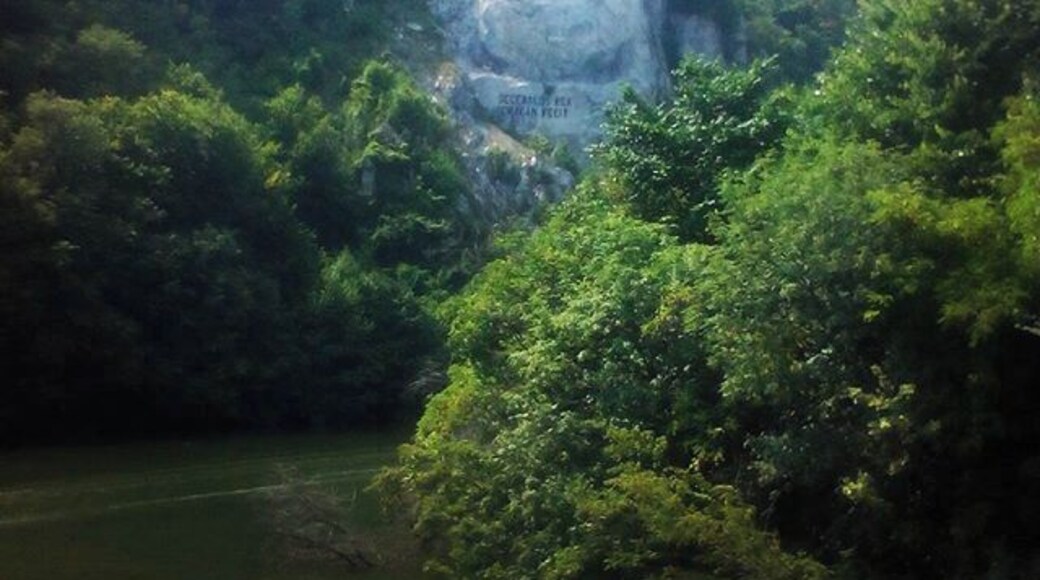
The rock sculpture of Decebalus  (Romanian: Chipul regelui dac Decebal) is a 42.9 m (141 ft) in height and 31.6 m (104 ft) in width carving in rock of the face of Decebalus (r. AD 87–106), the last king of Dacia, who fought against the Roman emperors Domitian and Trajan to preserve the independence of his country, which corresponded to modern Romania.
The sculpture was made between 1994 and 2004, on a rocky outcrop on the river Danube, at the Iron Gates, which form the border between Romania and Serbia. It is located near the city of Orșova in Romania.
It is the tallest rock relief in Europe.

The project of sculpting the colossal head of Decebalus was the brainchild of a wealthy Romanian businessman, Iosif Constantin Drăgan. In 1985, Drăgan chose the rock to be sculpted, an outcrop 128m in height located in the area of Iron Gorge, Danube. Perhaps one of the reasons Drăgan chose this site was due to the fact that the Tabula Traiana, a memorial to the Roman conquest of Dacia, was located on the opposite side of the river. 
After the sculpture was completed Latin inscription was put beneath it and is: DECEBALUS REX DRAGAN FECIT,  which meant “King Decebalus, made by Dragan”.
The best photographs are made while cruising if you are visiting from serbian side or from a bridge if you are already in Romania.
#InStone
#History
#Romania
#Serbia
#Danube
Decebalus is considered a national hero in Romania and has been portrayed in numerous literary works, movies, public sculptures, and other memorials.

The rock sculpture of Decebalus  (Romanian: Chipul regelui dac Decebal) is a 42.9 m (141 ft) in height and 31.6 m (104 ft) in width carving in rock of the face of Decebalus (r. AD 87–106), the last king of Dacia, who fought against the Roman emperors Domitian and Trajan to preserve the independence of his country, which corresponded to modern Romania.
The sculpture was made between 1994 and 2004, on a rocky outcrop on the river Danube, at the Iron Gates, which form the border between Romania and Serbia. It is located near the city of Orșova in Romania.
It is the tallest rock relief in Europe.

The project of sculpting the colossal head of Decebalus was the brainchild of a wealthy Romanian businessman, Iosif Constantin Drăgan. In 1985, Drăgan chose the rock to be sculpted, an outcrop 128m in height located in the area of Iron Gorge, Danube. Perhaps one of the reasons Drăgan chose this site was due to the fact that the Tabula Traiana, a memorial to the Roman conquest of Dacia, was located on the opposite side of the river. 
After the sculpture was completed Latin inscription was put beneath it and is: DECEBALUS REX DRAGAN FECIT,  which meant “King Decebalus, made by Dragan”.
The best photographs are made while cruising if you are visiting from serbian side or from a bridge if you are already in Romania.
#InStone
#History
#Romania
#Serbia
#Danube
Decebalus Rex Monument is the largest sculptures in stone across Europe
Our last king, the last king of Dacia.
Tallest rock-hewn sculpture in Europe, third tallest in the world.
#InStone

  • find price illustration

    Explore activities

    Explore thousands of experiences from activities and attractions to day tours and transfer.
  • calendar shield illustration

    Book with ease

    Skip the line- book tickets online in minutes to top attractions with free cancellation on many activities.
  • trophy illustration

    Treat yourself

    Members save % or more when you book activities.
What to do in Mehedinti County


Popular places to visit